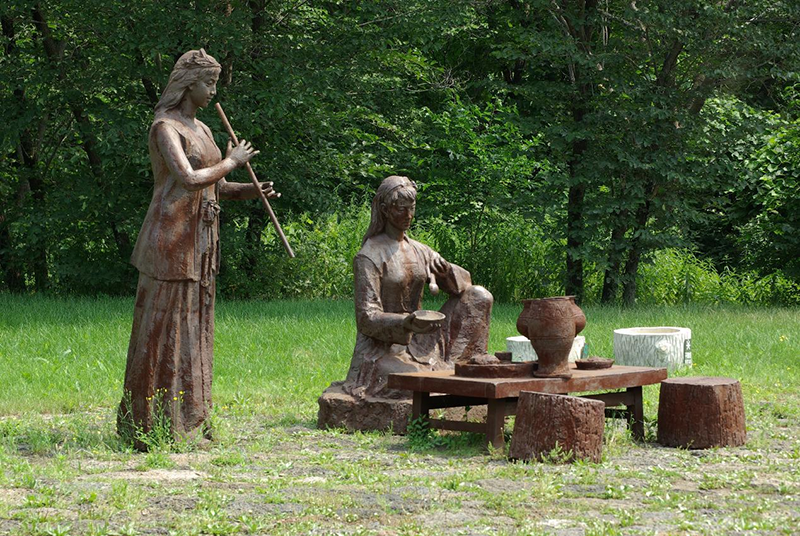
Bohai Gardencovers an area of10000The park covers an area of many square meters and features sculptures such as the "Ethnic Customs of Bohai Sculpture Group," "Guardians of the Law," "Historical Relief of the Rise and Fall of the Bohai Kingdom," "Statue of Da Zuorong," and "Self-Recommendation Paradise." Entering Bohai Park allows visitors to personally experience the customs and traditions of the Mohe people from the Bohai Kingdom over 1,200 years ago. The Ethnic Customs of Bohai Sculpture Group,Made of cast iron,The work vividly portrays the folk customs of the ancient Mohe people through realistic brushwork. HufasculptureThe stone lighthouse carved from volcanic rock and the one cast from cast iron7It is composed of several figures. The Stone Lighthouse, also known as the Stone Lantern, is a replica of the one in Xinglong Temple, Bohai Town, with the original dating back over 1,200 years. The relief mural depicting the rise and fall of the Bohai Kingdom is made of reinforced concrete and stands at a height of2meters, up to20m. The statue of Dae Jo-yeong is a granite sculpture, standing tall8meter, weight30The sculpture depicts the valiant and formidable Da Zuorong in his majestic bearing when he was conferred the title of General of the Left Brave Guard by the Tang Dynasty.
(Dear visitors, here we have the Bohai‑Nation Folk‑Custom Sculpture Group, cast in iron. With realistic artistic techniques, these works depict folk traditions of the ancient Mohe people.
Please look at this sculpture group of hunters. From their facial expressions, you can easily perceive their excitement, fulfilment and joy after a successful hunt. Next, this group portrays Mohe people warmly receiving guests travelling from afar, showing that the ancient Mohe were a hospitable, sincere and bold‑spirited nation. This third set captures the exhilaration of Mohe fishermen out fishing, reflecting their pursuit and longing for a better life. The final sculpture presents graceful poses of the Mangshi Dance, telling us that the Mohe were not only hard‑working and brave, but also a people gifted in song and dance.
These four lifelike sculptures complement one another. From diverse perspectives and dimensions, they vividly unfold the rich connotations and warm sentiments of Mohe folk customs.
Now please turn to this sculptural group titled Dharma Protectors. It consists of a volcanic‑rock carved stone lantern pillar and seven iron‑cast human figures. The stone lantern pillar, also known as the stone lamp stupa, is a replica of the original relic preserved at Xinglong Temple in Bohai Town, which dates back more than 1,200 years. This antique lantern is not only an art treasure with exquisite shape and fine carving, but also a ritual artefact imbued with auspicious meanings. As some of you may know, only two such 1,200‑year‑old stone lamp stupas survive across China today. One sits at Xinglong Temple, and the other is kept in a museum in Xi’an, Shaanxi Province. Symbolising light, good fortune, prosperity and thriving development, the stone lantern pillar was believed to possess sacred, inviolable spiritual power in traditional culture — this forms the core ingenuity of the designers. Positioned in front of the pillar stand the seven iron‑cast dharma protectors. Robust and full of vigour, each holds a weapon and fulfils his assigned duty of safeguarding the Dharma. Viewing the whole ensemble, one cannot help but marvel at the profound breadth of Buddhist culture.
This relief is built of reinforced concrete, standing 2 metres high and stretching 20 metres in length. As we stand before this long‑scroll relief narrating the rise and fall of the Bohai Kingdom, what feelings does this ancient kingdom stir within you? What reflections does it spark regarding the magnificent 5,000‑year‑old civilisation of the Chinese nation? Bearing witness to countless historical vicissitudes, the relief invites us to revisit long‑buried chapters of history and draw inspiration from them.
The Battle of Tianmen Ridge, 697 AD. This decisive battle shaped the fate of the Mohe people and laid an unshakable foundation for the Bohai Kingdom.
Da Zuorong Establishes the Zhen State, 698 AD. Leading the Mohe tribes, Da Zuorong founded this local ethnic regime.
The Investiture of Da Zuorong, 713 AD. Envoys from the Tang Dynasty arrived at the Zhen State, conferring official titles upon Da Zuorong: General of Left‑Xiaowei Army, Military Governor of Mohan Prefecture, and Prince of Bohai. The grand ceremony is vividly recorded in The Investiture Mural, which you may view inside No. 1 State‑Guest Villa.
King Da Wuyi (the Second Monarch) Expands Territories, 719 AD. After ascending the throne, Da Wuyi launched military campaigns on multiple fronts, expanding Bohai’s territory to span five thousand li in circumference.
King Da Qinmao (the Third Monarch) Moves the Capital, 762 AD. The Tang court formally recognised Bohai as a kingdom, enfeoffing Da Qinmao as its king and granting him the additional title of Inspector‑General. Da Qinmao relocated the royal capital from Dunhua in Jilin to Bohai in Ning’an.
Prosperity of the Bohai Kingdom. Under the tenth king Da Renxiu, the kingdom entered a period of revival. It reached its golden age under the thirteenth ruler Da Xuanxi, earning the historical epithet “the Prosperous State of the Eastern Sea”. The diligent and ingenious Bohai people created the brilliant “Eastern‑Sea Culture”, renowned through the ages.
Fall of the Bohai Kingdom. In 906 AD, the fourteenth king Da Weijie passed away, and the fifteenth king Da Yunzhuan ascended the throne. Plagued by internal conflicts and mounting crises, the kingdom grew fragile. Taking advantage of Bohai’s turmoil, Yelü Abaoji, founding emperor of the Khitan Liao Dynasty who long coveted Bohai territory, issued an imperial edict for a personal military expedition in December 925 AD. Khitan troops advanced unopposed. The already‑weakened Bohai Kingdom could offer little resistance and was conquered by the Khitans in 926 AD. Over its 229‑year history, fifteen successive kings ruled the Bohai Kingdom.)