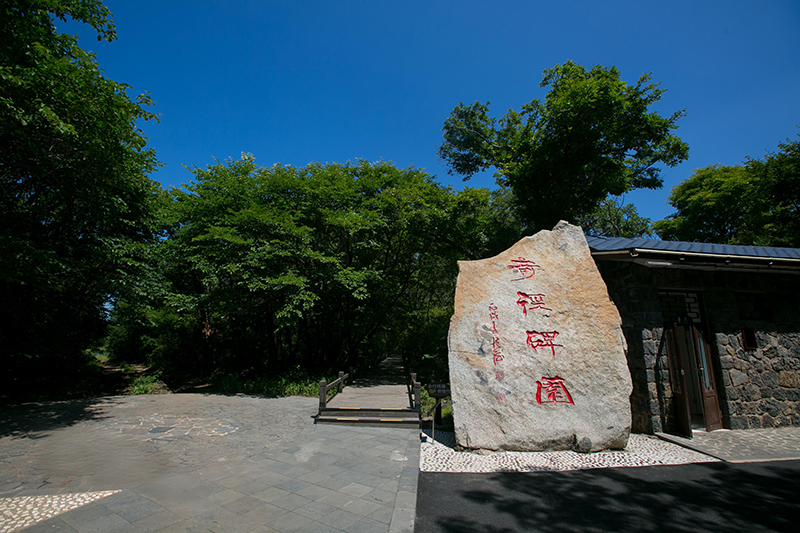
The Qijing Stele Garden, established in 2003, features the garden name "Qijing Stele Garden" inscribed by Mr. Zhang Hai, Chairman of the China Calligraphers Association. The Qijing Stele Garden is divided into nine sub-gardens, housing over 170 steles. Except for the self-recommendation stele garden, the poems in the other eight gardens were carefully selected from more than 500 poems praising Jingpohu. Renowned calligraphers in China were invited to write these poems, which were then engraved onto natural stones. Taking into account the terrain, vegetation, and forest along the "Shaoqi Path," steles of varying sizes were erected without damaging the natural surroundings, enhancing both the aesthetic appeal of the stones and creating a harmonious contrast and complement between human artistry and nature, blending scenery and sentiment into a unified whole.
(Dear visitors, Qijing Stele Garden was built in 2003 as a forest‑of‑steles scenic spot within the Jingpohu Scenic Area. Its name “Qijing Stele Garden” was inscribed by Zhang Hai, Chairman of the Chinese Calligraphers Association.
Qijing Stele Garden consists of nine sub‑gardens. Excluding the Self‑recommendation Garden, poems for the other eight gardens are carefully selected from more than 500 poems composed in praise of Jingpohu. Renowned Chinese calligraphers were invited to write these poems, which were then engraved on natural boulders. Taking full account of the landforms and vegetation along the “Shaoqi Path”, stone steles of varying sizes are placed among the woods. This layout avoids damage to local plants and trees while highlighting the ornamental value of the steles. Human‑made culture and natural scenery achieve perfect contrast and complementarity, blending feelings with setting in harmonious unity.
The nine sub‑gardens are listed as follows:
Celebrity Verses Garden: Exhibits calligraphy works by notable figures who have visited Jingpohu.
Masterly Brushworks Garden: Displays poems and calligraphy by China’s top‑tier calligraphers.
Odes to the Flying Waterfall: Features poetic calligraphy celebrating the Diaoshuilou Waterfall.
Reveries over Hongluonü: Presents poems and calligraphy inspired by the legend of Hongluonü.
Tracing Ancient Rhythms: Shows verses about Jingpohu, the ancient Bohai Kingdom and the Underground Forest.
Marvelous Natural Sights: Collects poetic calligraphy dedicated to major natural attractions of Jingpohu.
Sentimental Verses: Displays lyrical poems written for Jingpohu.
Spiritual Wanderings over Jingpohu: Contains poems and calligraphy inspired by visits to Jingpohu.
Self‑recommendation Garden: This is a cultural space reserved for visitors to show their talent. If you hold deep affection for Jingpohu and wish to leave your mark here, you may go through formal procedures to have your poems or messages engraved on natural stones in this garden.
Dear visitors, do you know how many steles there are in Qijing Stele Garden? Let me tell you: there are more than 170 steles in total, all carved on natural rocks. Some weigh less than one tonne, while the largest ones are nearly 100 tonnes. Whether small and delicate or huge and massive, each piece boasts its own unique charm. Every stele stands as an exquisite work in its own right.)